
Carmel Movers
Tax Deductions for Moving Expenses: What You Can Claim
Maximize Your 2026 Moving Deductions
Navigating the complexities of relocation tax deductions for moving expenses can be daunting, especially amid evolving IRS regulations. In 2026, understanding what you can claim and who qualifies for these deductions is crucial for anyone planning a move. This article provides a comprehensive overview of current IRS rules, the specific deductions available to military members, and how to claim them using IRS Form 3903. Additionally, we will explore Massachusetts-specific tax considerations and offer strategies for managing moving costs when tax deductions are unavailable. By the end of this guide, you will have a clear understanding of the evolving tax landscape and how to maximize your moving tax deductions, potentially leading to a larger tax refund.
Disclaimer:
This article is intended for informational purposes only and does not constitute tax advice. Tax laws are complex and subject to change. We strongly recommend consulting with a qualified tax professional or Certified Public Accountant (CPA) to discuss your specific situation and ensure compliance with all applicable tax regulations.
Understanding Historically Deductible Moving Costs (Pre-TCJA) and When Moving Costs Were Tax Deductible
Before the Tax Cuts and Jobs Act (TCJA) of 2017, many taxpayers were able to deduct qualified moving expenses on their federal tax returns. This deduction was primarily available to individuals who moved for work-related reasons and met specific IRS criteria. Understanding these historical provisions provides important context for the current tax landscape, especially since most general moving expense deductions are suspended for 2026.
What Expenses Were Generally Deductible?
Historically, if you met the IRS’s distance and time tests, you could deduct reasonable expenses for:
- Transportation and Lodging: The cost of traveling from your old home to your new home, including gas, oil, tolls, and lodging for yourself and members of your household. Meals were generally not deductible.
- Household Goods Transportation: The cost of packing, crating, and shipping your household goods and personal effects. This included expenses for hiring a moving company, renting a moving truck, or shipping by other means.
- Storage and In-Transit Insurance: The cost of storing and insuring your household goods and personal effects for any period of 30 consecutive days after the day your items were moved from your old home and before they were delivered to your new home.
Historical Requirements: The Distance and Time Tests
To qualify for the moving expense deduction, historically, taxpayers generally had to satisfy two main tests:
- The Distance Test: Your new main job location must be at least 50 miles farther from your old home than your old main job location was. If you had no prior job location, your new job location must be at least 50 miles from your old home.
- The Time Test: You had to work full-time for at least 39 weeks within the first 12 months after arriving in the general area of your new job location. Self-employed individuals had additional requirements.
These tests ensured that the move was genuinely work-related and significant enough to warrant a tax deduction or relocation cost tax deduction. However, as of 2026, these general deductions are suspended for most taxpayers, with the notable exception of active-duty military members.
What Are the Current IRS Rules for IRS Moving Expense Deductions in 2026?
The IRS has specific rules regarding IRS moving expense deductions that are essential for taxpayers to understand. In 2026, the Tax Cuts and Jobs Act (TCJA) significantly affected eligibility for these deductions, primarily affecting individuals.
How Does the Tax Cuts and Jobs Act Affect Moving Expense Deductions?
The Tax Cuts and Jobs Act, enacted in 2017, suspended moving expense deductions for most taxpayers through 2025. This means that, unless you are an active-duty military member, you cannot deduct moving expenses on your federal tax return for moves made after 2025. The TCJA aimed to simplify the tax code, but it also removed a valuable deduction and tax break for many individuals. However, military members can still deduct certain moving expenses related to a permanent change of station (PCS).
Are Moving Expenses and Relocation Costs Tax Deductible for Civilians in 2026?
As of 2026, civilians are generally not eligible to deduct moving expenses on their federal tax returns under the TCJA, which suspended the deduction through 2025 and did not reinstate it for 2026. This change has significant implications for individuals who are relocating for work or personal reasons. While civilians may not benefit from federal deductions, it is essential to explore state-specific deductions or credits that may still be available, offering potential tax credit opportunities.
Who Qualifies for the Military Moving Expense Deduction in 2026?
Military members have unique eligibility criteria for moving expense deductions that differ from civilians. Understanding these criteria is crucial for service members planning a move and claiming their moving expenses.
What Is the Active-Duty Military Exception?
The active-duty military exception allows service members to deduct certain moving expenses when they relocate due to a permanent change of station (PCS). This makes these moving expenses moving tax deductible for them. This exception is vital for military personnel, as it acknowledges the unique nature of their service and the frequent relocations they face. To qualify, service members must be on active duty and must meet specific criteria outlined by the IRS.
This financial burden has long been a concern for service members, as historical data indicate they often bear a significant share of their relocation costs.
What Constitutes a Permanent Change of Station?
A permanent change of station (PCS) refers to a military member’s official relocation from one duty station to another. This can include moves to a new base or a transfer to a different branch of the military. Understanding what qualifies as a PCS is essential for service members to ensure they can claim the appropriate moving expense deductions.
Which Moving Expenses Are Eligible for Deduction for Military Members?
Military members can claim various moving expenses under the active-duty military exception. Knowing which expenses are eligible for deduction can help service members maximize their tax benefits.
What Transportation and Storage Costs Can Be Claimed?
Eligible transportation costs for military members include expenses related to moving household goods and personal effects. This can encompass costs for hiring a moving company, renting a moving truck, and storage fees incurred during the transition. It is crucial to keep detailed records and receipts to substantiate these claims as deductible expenses.
How Are Travel and Household Goods Expenses Treated?
Travel expenses incurred during a move, such as lodging, can be deductible for military members, but meals are generally not deductible. Additionally, the costs of transporting household goods are deductible. Proper documentation is essential to ensure that these moving expense items are accurately reported on tax returns.
How to Claim Moving Expense Deductions and Ensure Proper Filing Using IRS Form 3903
Claiming moving expense deductions requires the completion of IRS Form 3903. Understanding how to fill out this form correctly is vital for military members seeking to maximize their deductions.
What Is IRS Form 3903 and Who Should Use It?
IRS Form 3903 is specifically designed for individuals claiming moving expenses. Military members who qualify for the moving expense deduction must complete this form to ensure their eligible expenses are reported accurately. The form requires detailed information about the move, including dates, locations, and the nature of the expenses incurred.
How to Complete IRS Form 3903 for Military Moves
Completing IRS Form 3903 involves several steps, including listing all eligible moving expenses and ensuring that the information aligns with supporting documentation. Common mistakes to avoid include failing to include all eligible expenses and failing to retain receipts. It is advisable to consult a tax professional if there are any uncertainties about completing the form or the filing process.
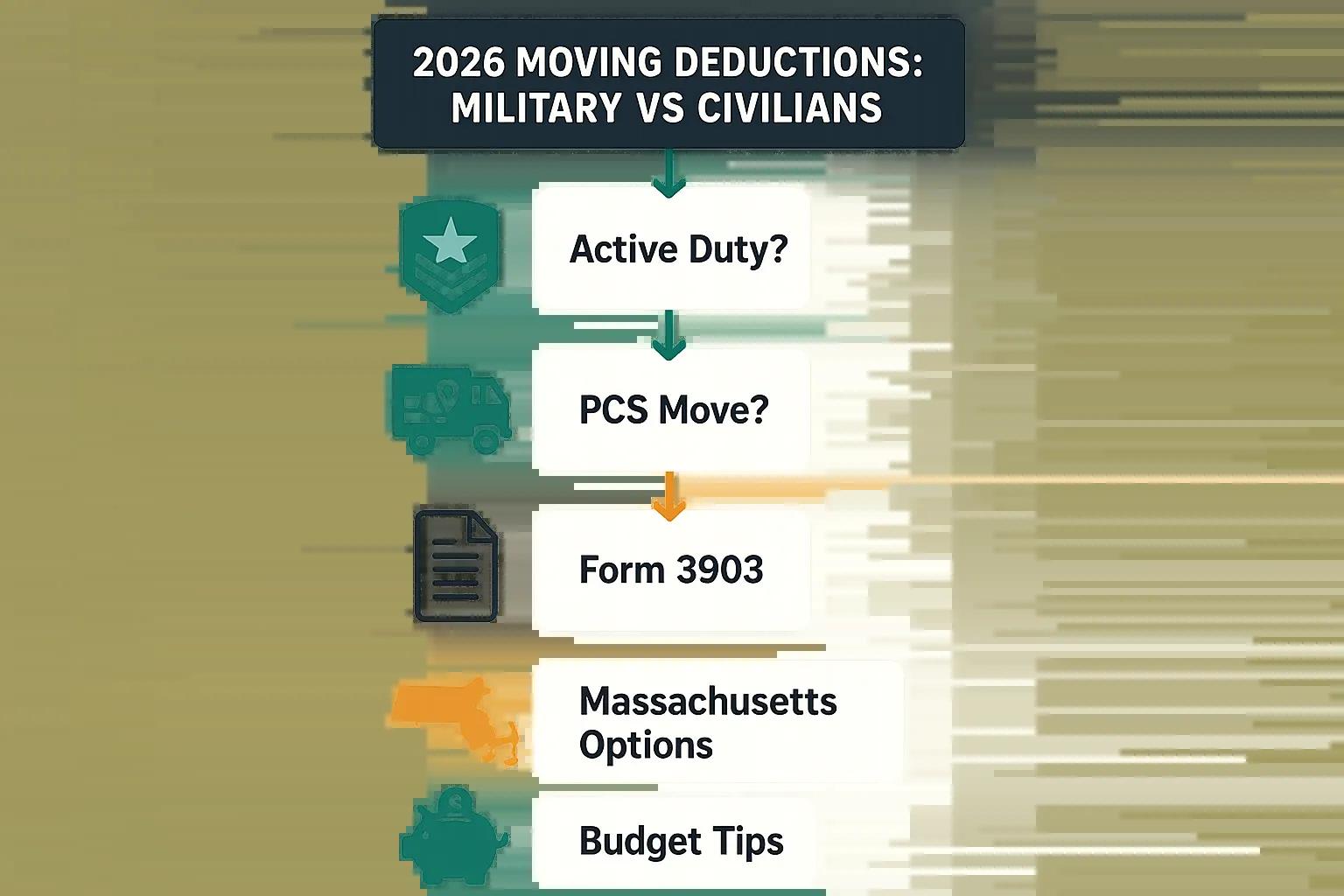
What Are the Massachusetts Relocation Tax Considerations for 2026?
When relocating to or within Massachusetts, it is essential to understand the state-specific tax considerations that may affect your moving expenses.
Are There State-Specific Moving Expense Deductions or Credits?
Massachusetts does not offer specific moving expense deductions for civilians, similar to federal regulations. However, it is essential to check for any applicable state credits or deductions, which could provide valuable tax breaks. Consulting with a tax professional familiar with Massachusetts tax laws can provide valuable insights into potential tax credit opportunities.
How to Plan Financially for a Move in Massachusetts When Relocation Costs Are Not Tax Deductible Federally
Planning for a move in Massachusetts without federal tax deductions requires careful budgeting. Consider all potential costs, including moving services, packing supplies, and any additional expenses that may arise during the relocation process. Exploring affordable moving solutions can also help mitigate costs.
How Can You Manage Moving Costs When Tax Deductions Aren’t Available?
When tax deductions are not available, managing moving costs effectively becomes crucial. There are several strategies to consider to reduce expenses during a move. Exploring potential tax breaks where available is also wise.
What Affordable Moving Solutions Does Carmel Movers Offer in Massachusetts?
Carmel Movers offers several affordable moving solutions in Massachusetts, including:
- Local and Long Distance Moving: They provide services for both local and interstate moves.
- Packing Services: Specialized packing services to ensure belongings are securely packed.
- Storage Solutions: Options for storing items during the move.
- Senior Moving Services: Tailored services for seniors to assist with their specific moving needs.
- Commercial Moving: Services designed for businesses relocating.
- Last Minute Movers: Assistance for urgent moving needs.
- Loading and Unloading Services: Help with loading and unloading trucks or storage units.
Carmel Movers emphasizes affordability without compromising quality, making them a trusted choice for a wide range of moving needs.
What Strategies Help Reduce Moving Expenses Without Tax Benefits?
To reduce moving expenses without the benefit of tax deductions, consider the following strategies:
- Budgeting: Create a detailed budget that outlines all potential moving costs to avoid overspending.
- Comparing Quotes: Obtain multiple quotes from moving companies to find the best deal.
- DIY Options: Consider renting a truck and handling the move yourself to save on labor costs.
- Timing: Plan your move during off-peak seasons to secure lower rates.
By implementing these strategies, individuals can effectively manage their moving costs, even without tax deductions or other tax breaks.
Please note: The information provided in this article is for general guidance only and does not constitute professional tax advice. Always consult with a qualified tax professional or CPA for advice tailored to your individual circumstances.


